Workforce Equality Monitoring Report 2025 - 26
Content
Introduction
General context
Summary
Improving the diversity profile of the workforce
Improving equality monitoring
Workforce profile
Recruitment
Starters and leavers
Training
Discipline and grievance
Appraisal
Redeployment
Promotions
Actions taken and next steps
Conclusion
Introduction
The Scottish Ambulance Service (SAS) collects equality data from both current workforce and prospective candidates through the recruitment and selection process. This information is collected at the application stage of the recruitment process, at short listed stage, at the appointment stage, through our engagement process and through surveying current staff.
Gathering this information is important to SAS and adds value to our Service by enabling us to:
- monitor the diversity of our workforce
- take action where any trends / patterns of inequality emerge
- monitor the implementation and progress of our Equality Outcomes and actions
- provide evidence to support equality impact assessments
- meet our general duties under the Equality Act 2010
Employee data is monitored across the protected characteristics of age, disability, gender reassignment, marriage and civil partnership, pregnancy and maternity, race, religion or belief, sex and sexual orientation as defined in the Equality Act 2010.
How we use employee information
This report assists SAS to routinely analyse equality monitoring information, which helps to identify trends where further action may be required to address any areas of inequality in the workplace thus eliminating potential unlawful discrimination. By capturing equality data during the recruitment process, we can take any actions required to advance equality of opportunity for both staff and external applicants.
The collection of equality data highlights areas where there is under representation across the protected characteristics and helps to identify where steps can be taken to improve the diversity of the workforce. The content of this report also provides evidence for consideration when reviewing progress associated with the implementation of equality outcomes and how future outcomes will be developed.
Equality monitoring data also assists SAS to establish whether actions taken have had a positive impact. For example, the data collected has assisted us with the examination of recruitment activity across equality groups to establish where candidates have been successful and what further steps can be taken to make improvements. We have also been able to show some improvement in the collection of data, although action taken to improve recruitment rates of some groups was less successful.
2. General context
Equality monitoring information has been collected during 1 April 2025 – 31 March 2026 from the NHS Scotland Standard Application Form (online) via JobTrain for potential candidates. The equality monitoring and personal details are held on a separate section of the forms before applicants are short-listed to ensure such details are not taken into account. Equality details are also collected on appointment via the staff engagement form and entered on the individual’s personal record. Staff can decline to provide specific details if they wish to do so. Only a limited number of individuals have access to this information for reporting purposes.
We are reviewing our approach with regard to the use of the self-service element of our current systems infrastructure. We recognise that access to this would improve levels of self-disclosure if staff could have access to amend their own personal details.
As of, 1 April 2025 SAS employed 6603 staff and as of 31 March 2026 SAS employed 6759.
The workforce consists of 49% female and 51% male staff. We have seen another increase in the number of women employed this year, which has steadily increased from 31% in 2007.
SAS currently captures robust data regarding age and sex however, data on the protected characteristics of disability, gender reassignment, race, religion or belief and sexual orientation is more limited and therefore not covering the whole workforce. we are committed to continuing to make progress to improve data compliance in a range of areas for disclosure and recruitment.
The SAS age profile continues to be broadly reflective of the working age profile of Scotland with 40% of staff employed between the ages of 45 – 59 and 13.4% of staff who are under the age of 30. Across NHS Scotland the number of people over 55 has increased from 19.7% ten years ago to 23.2%. SAS figures follow this trend.
We have seen an increase in the percentage of staff disclosing equality information for religion and belief, disability and sexual orientation. Numbers disclosed for race have gone down with numbers for age, sex and gender reassignment remain the same. Our aim is to take sustained action to encourage further improvement of disclosure rates.
Further details of the actions already taken and future actions can be seen in sections 4 and 14. This will include an update on actions taken which link to Equality Outcomes, detailed in 2025-2029 Mainstreaming Report. The Gender Pay Gap Report was also published in April 2025
Summary
Progress has been made across a number of areas during the period April 2025 – March 2026.
- Improving the diversity profile of the workforce
It remains our ambition that our workforce is reflective of the population we serve in Scotland as this helps us in meeting the needs of our communities.
Vacant posts are advertised in a variety of ways in order to reach across minority groups and those who have a disability to encourage more applications from these communities. We remain committed to working to identify ways of reaching out to diverse communities to encourage applications and will actively seek new ways to improve our engagement across all areas. The universities have similar strategies and this should begin to reflect in our workforce through our recruitment of newly qualified paramedics.
We have seen a large increase over the last year in the percentage of applications from ethnic communities and a slight decrease in the percentage of applications from the LGBT+ communities. By increasing our engagement across these communities, we hope to see the number of applicants, from these and other groups to increase, which will in turn lead to a greater representation across the Service.
We have seen an increase in the proportion of applicants providing all equality information with 93.4% of applicants doing so during 2025/26 (87.8% in 2024/25). The largest gap is for the disclosure of sexual orientation with 5.0% of applicants preferring not to provide this information.
Further details of the actions already taken and future actions can be seen in sections 4 and 14. This will include an update on actions taken which link to Equality Outcomes, detailed in 2025-2029 Mainstreaming Report. The Gender Pay Gap Report was also published in April 2025
- Improving equality monitoring
Improving rates of employee self-disclosure of equality monitoring data is important if we are to better analyse recruitment and employment trends and identify appropriate actions to take forward. It is encouraging to see increases were made in disclosure rates for all categories. Work continues to reduce the gap to have a fuller picture of the diversity of the workforce.
As of 31 March 2026, 65.6% of staff had provided all equality monitoring details. This is a slight increase from the 31 March 2025 as the figure was 64.8%. Further details of the actions being taken can be seen at section 5.
We said in our 2024/25 workforce equality monitoring report that we would take a number of steps which would help improve the diversity profile of the workforce and also improve equality monitoring. These can be seen at section 14.
4. Improving the diversity profile of the workforce
SAS still has some way to go before the equality profile of SAS matches those of Scotland as a whole, particularly with regard to the number of young people, those from BAME groups and those who have a disability.
Details of the workforce profile against each of the protected characteristics can be seen at section 6. Recruitment activity and the diversity profile of applicants who have applied for posts during 2025/26 can be seen at section 7.
We said in our 2024/25 workforce equality monitoring report that we would take a number of steps in relation to improving our diversity profile. Some of these actions link directly back to the progress on our Equality Outcomes. This is what we did, the results and what we plan to do next.
4.1 Identify and attend specific careers events / fairs in areas with higher minority ethnic
| Actions | Results | Next Steps |
|---|---|---|
|
We have previously engaged in some work targeting career type events for young people and particularly those from ethnic backgrounds. The action we agreed to follow on from this was to review progress to date in this area, identify any barriers to delivery and potential solutions and areas where success can be increased. |
Work in this area is ongoing. Opportunities for mentorship in operational areas is challenging given the nature of the work. Further opportunities are being explored in corporate areas, where they can be more easily supported. |
We are currently in discussion with the King’s Trust to develop a proposal and funding bid for paid placements for young people, targeting areas of high deprivation and also where there may be higher rates of young people from ethnic minorities. |
|
Through Community Engagement activity, work with the Senior Leadership Team (SLT) across SAS is underway to increase the number of potential opportunities for young people from higher ethnic minority areas. Online educational presentations are being delivered to schools and classrooms across the country via Microsoft Teams. Engagement with 18 primary schools across Edinburgh continues with a series of presentations that cover emergency healthcare topics based on what young people’ interests. |
A Team Leader from the West Region has coordinated, led and engaged in a significant number of BME/Multi faith community events, e.g. NHS GGC South Asian Heritage Month, various CPR events The Community Engagement Officer has undertaken extensive engagement with primary schools, head teachers and health curriculum coordinators to co-design a series of presentations including `who We Are', `Calling 999’, and `How to Stay Safe in an emergency’. These are available on @SAS and will support operational staff during school visits to provide information relevant to both teachers and students. |
Various ways and means to enable teachers to deliver these presentations continue to be explored in order to reduce need for staff attendance, given the limited resources due to operational demands |
|
Equality Outcomes (5&6) are a key area of focus for the Ethnic Minority Forum by its members and allies. We will actively work to reach out to all staff and allies to maintain the momentum which has allowed this work to really take off this year. |
See p48-50 of the Mainstreaming report for actions linked to Equality Outcome 5 and 6.
Applicants from ethnic communities have increased from 29.8% in 2024/25 to 37.5%. |
Operational staff supported to attend key ethnic-focused community events.
Our Anti-Racism plan is due to be published at the end of September 2026. |
4.2 We will aim to increase the employability for young people and those from minority ethnic communities
| Action | Results | Next Steps |
|---|---|---|
|
Through our Young Minds Saves Lives programme, we are now focussing on the career aspect of the project through co-design and feedback from young people. There is now a much greater interest in learning about the career opportunities available in SAS, and the appetite for this has grown since the delivery of the co-designed lessons. We plan on taking a group from each school to take part in SAS career awareness days, where they will visit various SAS locations, learn about that particular operation and the different roles available. A pilot training programme to develop secondary pupils as Youth Health Ambassadors to define the strategy is underway. A working group is being set up to progress this work. |
In partnership with Developing the Young Workforce, 14 young people attended a SAS career awareness day, during which they visited the Air Ambulance base and learned about various operations and roles within the service, including hands-on skills training. Through the DYW Pathway to Employment programme, which provides practical skill development to enhance confidence and resilience, these pupils have gained a comprehensive understanding of workplace expectations, thereby improving their overall employability and problem-solving abilities. Through our partnership with the King's Trust, we have supported 15 young people involved in a “Getting into the NHS” employability programme. We provided an overview of the service, the variety of roles available and the pathways into them. We also organised visits to the ambulance control centre and delivered practical, hands-on skills training. |
We are expanding YMSL's mental health component through co-design with young people, including Escape Room challenges. The new mental health lessons will also support those interested in related careers. We will continue to strengthen our partnership working with Developing the Young Workforce and the King's Trust, while exploring opportunities to develop relationships with additional organisations that support young people. This will ensure we continue to deliver career awareness and employability activities for both school pupils and young people who have left school and are being supported into employment. Through these partnerships, we will promote careers within the NHS and ambulance service, helping young people understand the range of opportunities available. We are also in the early stages of exploring mentorship opportunities within partner schools to provide additional support, guidance and inspiration for young people considering future career pathways. |
|
HR and Education colleagues to look at which areas of SAS could realistically be considered to encourage an ongoing and sustainable flow of Modern Apprentices. This would support the aim of increasing the employability of young people in SAS, particularly those from minority ethnic backgrounds. |
In 2025/26, we were not able to pursue the Modern Apprenticeship programme. However, we continued to offer a student placement within the Workforce Directorate to support their development through a structured career development plan. This individual is now working within the People Services Hub on a bank basis. In addition, we have recruited an intern from Inclusion Scotland to support our EDI work. |
|
4.3 We will utilise contacts with third sector partners to identify further ways to advertise recruitment vacancies
| Actions | Results | Next Steps |
|---|---|---|
|
We will continue to develop contacts with third sector partners during 2025/26, for example Dyslexia ScotWest, Inclusion Scotland and Deaf Scotland. |
We have continued to engage with third sector partners, including Deaf Action, Deaf Scotland and the Scottish Ahlul Bayt Society, and we are able to use these contacts to advertise posts. Through NES, we have developed an e-learning resource to raise awareness of dyslexia. Positive feedback from staff has been forthcoming. |
We will continue to develop contacts with third sector partners during 2026/27. We will also continue to engage with other ambulance services and agencies to learn from areas of success and understand how they are using these services through the various networks in which we are involved. Going forward, we are working closely with Dyslexia ScotWest, which will support the development of a dyslexia-friendly service. |
4.4 Ensure all selection panels have a gender mix
| Actions | Results | Next Steps |
|---|---|---|
|
We will further explore this as we develop our HR/ER Hub and reporting mechanisms. When the OFS Safer Pre and Post Employment policies are launched, we will ensure all training and support provided to managers captures this key element. The recruitment and selection policy and training manual will be reviewed to include the most up-to-date guidance. CPD sessions on reducing bias in recruitment and selection have been developed by our OD team. These will be incorporated into all management development training and will also be available online for all staff. |
We have worked with our ICT teams to explore how we can better develop our internal systems to address this gap in data reporting. We are trialling systems for recording and reporting purposes. CPD sessions are regularly accessed by staff. The OFS policies were released in August 2025, and work is ongoing to update relevant policies and processes. |
We will continue to encourage managers to plan panels with a gender mix. We will further develop and implement systems for recording and reporting on EDI data through the People Services Hub. CPD sessions will be updated in line with the latest OFS policies. Policies, training and development materials will be updated. The recruitment and selection policy and training manual will be reviewed to include the most up-to-date guidance. |
5. Improving equality monitoring
It is accepted that there is still work to be done to improve the capture of equality information to enable a fuller analysis of workforce data. The chart below illustrates the gaps by percentage in disclosure rates across the different protected characteristics.
Chart 1 – as of 31 March 2026
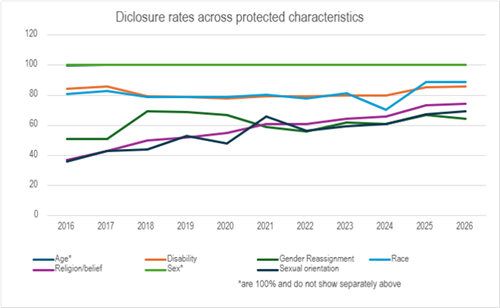
Chart 1 shows the rate of disclosure across each of the protected characteristics. Progress is being made to increase staff self-disclosure rates. Disclosure rates for all protected characteristics have increased this year.
Staff applying for posts during their employment will complete these details at application stage and personal records are updated accordingly.
Next steps
We said in our previous workforce equality monitoring report that we would take some actions, in relation to improving disclosure rates and better capturing equality monitoring data. These actions and results can be seen in the table overleaf.
5.1 For staff attending learning in practice sessions provide equality monitoring forms and prepaid envelopes for the education and professional development team to distribute
| Actions | Results | Next steps |
|---|---|---|
| Digital forms to be sent out to all new and current staff in the last quarter of 2025/26. | This has been delayed as the digital capture of EDI data has been reviewed. NHSS. However, we have continued to capture EDI data via other mechanisms. |
|
| Review statistics on completion of the module on Turas and follow up on any areas of low uptake. |
The EDI statutory and mandatory training has now been launched on the Turas platform. Completion rates are starting to rise across all functions. See also pages 48–50 of the Mainstreaming Report for actions linked to Equality Outcome 5. |
|
| Following completion of the DPIA process, roll out our survey. Paper formats will also need to be made available in local areas. | As detailed in section 5.1. | A survey will be sent to staff by email to encourage the disclosure of equality monitoring information. |
5.2. Identify and agree with local management teams which additional areas to prioritise for additional support
| Actions | Results | Next steps |
|---|---|---|
| Following completion of the DPIA process, roll out our survey. Paper formats will also need to be made available in local areas. | As detailed in section 5.1. | A survey will be sent to staff by email to encourage the disclosure of equality monitoring information. |
6. Workforce Profile
6.1 Chart 2 – Age as on 31 March 2026
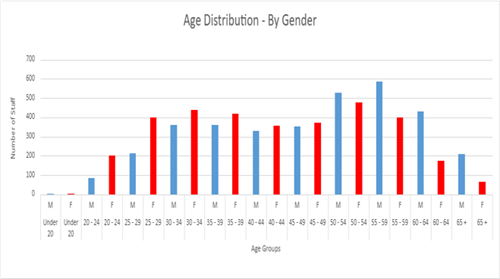
Chart 2 illustrates the age distribution of all staff. 53.1% of staff are age 45 and over. The age group with the highest proportion of females is 50-54 (14.4%), this age group also holds the highest percentage of males (17%). This is historically reflective of a more male-dominated service. However, the shift in gender shown in the younger age groups is becoming more balanced. The most underrepresented groups in terms of age and the workforce profile are those under 20, representing a combined 0.1%. This spread of staff across the age groups is similar to that reported for previous years
Charts 3 and 4 below illustrate the age distribution of staff by full-time and part-time.
Chart 3 – as on 31 March 2026
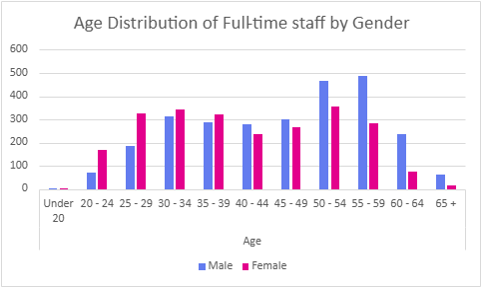
75.1% of staff work on a full-time basis which is a slight decrease from last year (77.5%).
Overall, there are more males (52.9%) working full time than females (47.1%). The older age groups see a greater difference. There is a significant increase in males working part time and full time over the age of 60.
Chart 4 - as on 31 March 2026
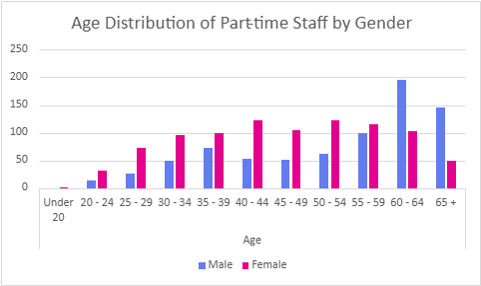
The number of staff working part time in 2025/26 has again slightly increased over the last two years, starting at 20.31% in 2023/24, increasing to 22.5% in 2024/25, and now increasing once again to 24.9% in 2025/26. Most staff working part-time are women (54.4%). Across NHS Scotland in 2025/26, the numbers of part-time staff working in both medical and non-medical workforce dropped. For non-medical workforce this figure was 36.45%. Of these the majority were women in 2024/25 (latest figures still to be published), with the greatest difference in average WTE between male and females between the ages of 35-44 and 60-64. However, we can see from SAS data that more men than women work part-time over the age of 60.
Chart 5 – as on 31 March 2026
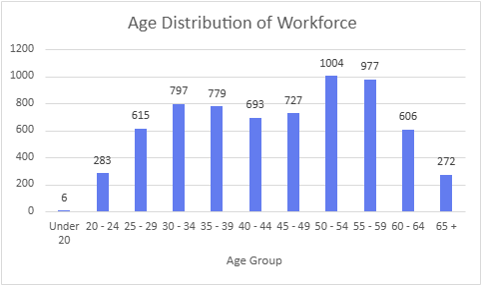
Chart 5 profiles the age distribution of the overall SAS workforce which is similar to previous years. Staff between the ages of 50-54 and 55-59 represent the largest groups. We have seen the overall age profile of the workforce increase and this is consistent with the rest of NHS Scotland.
6.2 Disability
The number of people completing this section of the equality monitoring form has increased but the percentage of staff disclosing they have a disability has remained at 2% from 2024/25. We are unsure why this is the case and will explore this further. Across NHS Scotland, 1.8% of staff have disclosed a disability. The percentage of the Scottish population with a long term, activity limiting health problem or disability was 21.4% at the Census in 2022 (19.6% in 2011).
We have renewed our commitment to the Disability Confident Standard and have been awarded the level 1 award. We have now upgraded to the level 2 award. In keeping with the Disability Confident Standard, we write to staff on an annual basis under the ‘Positive about disabled people’ initiative. This scheme helps to encourage individuals with a disability to discuss this with their line manager to establish if any assistance can be provided to help them in the workplace by way of reasonable adjustments.
We are currently employing an intern through Inclusion Scotland. This Inclusion Support Officer is undertaking a project to identify the challenges and fears of staff disclosing their disabilities to their seniors and colleagues. In addition, they are developing a Manager’s Toolkit on how to deal with staff who disclose their disabilities and provide reasonable adjustments and support for a more positive experience. Initial results from staff survey has shown a slight increase in response rates. Further details will be made available as this work progresses.
The percentage of staff who have chosen not to provide details of their disability has slightly decreased to 19.9% in 2025/26, whereas, in 2024/25, this figure was20%.
6.3 Pregnancy and maternity
Table 1
| Number on maternity leave during | Number who returned to work | Percentage who returned to work | Number returning on a flexible basis | Percentage returning on a flexible basis |
|---|---|---|---|---|
| 77 | 52 | 67.6% | 22 | 42.3% |
The table above illustrates the number of women who have taken maternity leave during the period 2025/26, those who have returned and the number returning on a more flexible basis. Women who return to work on a flexible basis are able to request to do so on reduced hours, different shift patterns, or by working on different days of the week.
Some of the women who have commenced maternity leave during 2024/25 have returned to work during 2025/26 and others will be due to return in the coming months.
6.4 Ethnicity
The 2022 Census indicated that 89.8% of the people in Scotland stated that they were born in the UK. Ethnicity cannot be identified by place of birth. 12.9% of people in Scotland were from minority ethnic groups (Census 2022), an increase from 8.2% in the 2011 Census. This is a larger increase than over the previous decade (from 4.5% to 8.2%). This has increased over several different groups.
Across NHS Scotland 6.7% of staff have disclosed they are from BAME backgrounds. Of the 6,603 staff employed by SAS of 31 March 2025, 1.2% disclosed they were from BAME backgrounds (1.2% in 2023/24).
Table 2: Ethnicity of the SAS workforce
| Ethnic group | Headcount | Percentage |
|---|---|---|
| African – African, African Scottish or African British | 80 | 1.2% |
| African – Other | ||
| Asian – Chinese, Chinese Scottish or Chinese British | ||
| Asian – Indian, Indian Scottish or Indian British | ||
| Asian – Other | ||
| Asian – Pakistani, Pakistani Scottish or Pakistani British | ||
| Caribbean or Black – Black, Black Scottish or Black British | ||
| Caribbean or Black – Other | ||
| Mixed or Multiple Ethnic Group | ||
| Other Ethnic Group – Other | ||
| White – Irish | 40 | 0.6% |
| White – Other * | 131 | 2% |
| White – Other British | 749 | 11.2% |
| White – Polish | <5 | <0.1% |
| White – Scottish | 4,583 | 67% |
| Did not disclose/unknown | 1,174 | 18.1% |
* Includes Polish, Gypsy Travellers and other White groups.
Table 2 illustrates the ethnicity of the SAS workforce as of 31 March 2026. Of those staff who had disclosed their ethnicity, there were 80 staff from BAME groups and 5,505 (81.4%) from non-BAME groups. A further 1,174 (17.4%) have not disclosed their ethnicity. This is very similar to last year.
Table 3: Non-disclosure by percentage| 2014 | 2015 | 2016 | 2017 | 2018 | 2019 | 2020 | 2021 | 2022 | 2023 | 2024 | 2025 | 2026 |
|---|---|---|---|---|---|---|---|---|---|---|---|---|
| 21% | 19% | 19% | 17% | 21% | 21% | 21% | 19.5% | 22% | 18.6% | 18.2% | 18.1% | 17.4% |
Table 3 shows that the percentage of staff who have chosen not to provide details of their ethnicity has decreased to 17.4%. Across NHS Scotland, those who declined to disclose their ethnicity account for 7.7% of all staff, while ethnicity was recorded as “not known” for 14.3%.
As data on staff ethnicity is incomplete, it is not possible to determine the exact percentage of staff from different ethnic groups.
Religion or belief
32.2% of the SAS workforce have chosen not to disclose their religion or belief. While disclosure rates have steadily increased from 27.5% in 2015 to 67.8% in 2026, there are still significant gaps.
Across NHS Scotland, the “not known” category for religion or belief accounts for 18.8% of the workforce. Those reporting “No Religion” account for 34.1%.
Scotland remains a place of diverse religious and faith communities. For the first time in Scotland’s 2022 Census, the majority of people said they had no religion. In 2022, 51.1% of people reported having no religion, up from 36.7% in 2011.
Chart 6
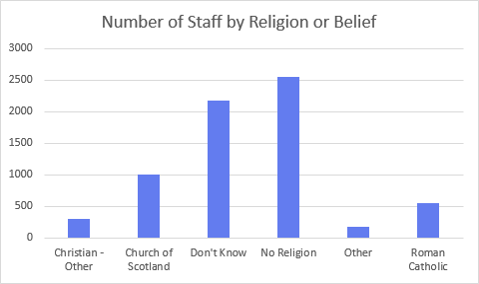
Chart 6 illustrates that no religion and those choosing not to disclose/do not know represented the largest groups of those staff disclosing religion or belief.
6.6 Gender
Chart 7
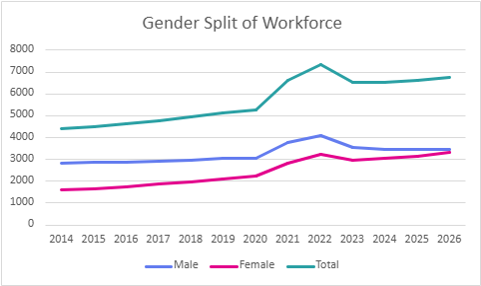
Chart 7 shows the number of women employed by SAS has continued to rise since 2024. Developing from 3,069 (2024, 46.86% of total) to 3,312 in 2026 (49% of total workforce). Historically the Service was predominantly male compared with the rest of the NHS Scotland, which is predominantly female (78.8% as at March 2025). Nursing and midwifery posts accounted for the majority of female staff in NHS Scotland with the majority of female staff at SAS are employed as Ambulance Care Assistants, Control Room staff, or in admin and clerical roles. The majority of Newly Qualified Paramedics are female (70.1%). There is an increase in the proportion of men and women applying for posts traditionally occupied by the opposite sex, i.e. more male applicants for admin and clerical posts and more female applicants for Patient Transport Service.
6.7 Band and Gender
Chart 8 and Table 4 illustrate the gender split by salary pay bands.
Chart 8
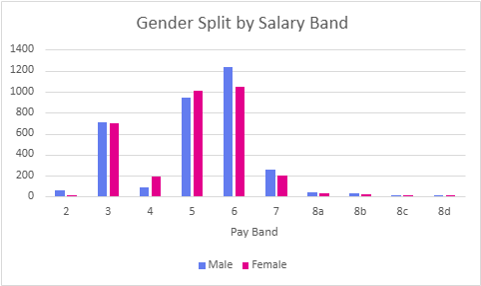
Table 4
Number of employees
| Pay band | Female | Male |
|---|---|---|
| 2 | 16 | 58 |
| 3 | 697 | 704 |
| 4 | 195 | 85 |
| 5 | 1010 | 948 |
| 6 | 1050 | 1238 |
| 7 | 203 | 255 |
| 8A | 32 | 42 |
| 8B | 26 | 33 |
| 8C | 14 | 13 |
| 8D | 6 | 7 |
Women are represented across all salary pay bands. Career progression can be seen as staff remain with the service over long periods. This is already beginning to be reflected, with women now representing the majority in Band 8c positions.
Of the executive team, 50% are women and 50% are men (not including Regional Directors). The proportion of women employed in bands 6 - 8 has increased to 39.6% (37.5% 2023/24), although numbers of women in all but Band C are lower. Further details relating to gender and pay bands can be seen in the Equal Pay Statement and Gender Pay Gap Information 2025.
6.8 Sexual orientation
Table 5 below illustrates the sexual orientation of staff by headcount and percentage.
| Sexual Orientation | Headcount | Percentage |
|---|---|---|
| Bisexual | 121 | 1.8 |
| Gay or Lesbian | 209 | 3.1 |
| Hetrosexual | 3972 | 58.8 |
| Other | 14 | 0.2 |
| Prefer not to say | 2443 | 36.1 |
36.1% of the SAS workforce have chosen not to declare their sexuality. Disclosure rates have improved from 26.5% in 2015 to 63.9% in 2026. Across NHS Scotland, sexual orientation has been disclosed for 69.6 % of all staff. “Scotland’s Census included a new question on trans status or history in 2022. This means we do not have comparable data for previous censuses. The census found that there were 19,990 trans people in Scotland. This is 0.44% of people aged 16 and over (Census 2022)”.
Of the staff at SAS 4.9% have disclosed that they are from the lesbian, gay, bisexual or other community compared with 3.3% for staff across NHS Scotland.
6.9 Marital Status
Table 6 below illustrates the marital status of staff by headcount and percentage.
| Marital Status | Headcount | Percentage |
|---|---|---|
| Civil Partnership | 32 | 0.5 |
| Divorced | 286 | 4.2 |
| Married | 2922 | 43.2 |
| Single | 3284 | 48.6 |
| Widowed | 22 | 0.3 |
| Did not disclose/do not know | 213 | 3.2 |
Disclosure rates for marital status have slightly increased from 96% to 96.8%.
We will continue to monitor marital / civil partnership status as this is one of the protected characteristics included in the Equality Act 2010 and is part of the public sector equality duty in respect of the requirement to have due regard to the need to eliminate discrimination.
7. Recruitment
The recruitment team dealt with 6,193 applications for employment during the period 2025/26 (6,267 in 2024/25) and 545 roles were advertised (345 in 2024/25). Of these 8.8% of applicants were successful compared with 6.2% the previous year.
The Job Train recruitment system is used across NHS Scotland and all applications received during 2025/26 have been managed through this system. Steps have been taken to advertise posts more widely to attract a more diverse mix of applicants.
Examination of recruitment data across equality groups is undertaken based on:
- number of applications
- number of applications shortlisted
- number of candidates successful at interview stage
7.1 Age
Chart 9 below illustrates the number of applicants from each age group against their respective success to short listing stage and being offered posts. Table 7 breakdowns the number of applicants per age group by percentage.
Chart 9
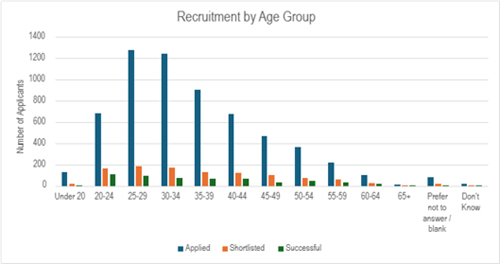
Table 7
Age Group by Percentage
| Under 20 | 20 - 24 | 25 - 29 | 30 - 34 | 35 - 39 | 40 - 44 | 45 - 49 | 50 - 54 | 55 - 59 | 60 - 64 | 65+ | Prefer not to answer | Don't know | |
| Applied | 2.1 | 11 | 20.6 | 20.1 | 14.6 | 10.9 | 7.6 | 5.9 | 3.6 | 1.7 | 0.2 | 1.3 | 0.3 |
| Shortlisted | 1.6 | 15.2 | 17.7 | 16.2 | 12.3 | 11.3 | 9.3 | 6.7 | 5.5 | 2.3 | 0.1 | 1.6 | 0.3 |
| Successful | 1.3 | 19.6 | 17.4 | 13.4 | 11.7 | 11.7 | 6.6 | 8.6 | 5.9 | 2.9 | 0.2 | 0.4 | 0.3 |
The largest proportion of applicants came from the 25-29 age group with 17.4% of applicants being offered posts.
The most successful applicants came from the 20-24 age group and represented 11% of all applicants, with a success rate of 19.6%. Last year the most successful age group was 30-34. The least successful applicants came from the 65+ age group. This party represented 0.2% of applicants and 0.2% of offers.
The number of applicants who preferred not to disclose their age accounted for 1.3% of all applicants (1.2%% in 2024/25).
7.2 Disability
The percentage of applicants disclosing a disability in 2025/26 was 12.5% (12.7% in 2024/25).
Of these 19.4% were shortlisted (15.8% last year) and 15% who had a disability were successful (15.3% in 2024/25). The Service complies with the Disability Confident Standard and applicants who are disabled can be considered under the Job Interview Guarantee initiative if they meet the essential criteria for the post and therefore a greater proportion of disabled applicants go through to interview stage compared with other groups. 155 applicants who selected this initiative were interviewed.
7.3 Gender reassignment
The Job Train system has introduced capabilities allowing us to report on gender reassignment. Although we can now report on this information, the numbers in the shortlisted and successful categories are too small to be reported without risk of identifying individuals. 0.6% of applications received were from candidates who identify as a trans person. This is a slight increase from last year (0.5%)
A number of applicants advised that they had either undergone, or were planning to undergo, gender reassignment surgery. Again, the numbers were too small in the shortlisted and successful categories to report on.
7.4 Ethnicity
Table 8
Ethnicity by Headcount
| Year | White Scottish | White other British | White Irish | Any other white background | Black, Asian & minority ethnic | Prefer not to answer / unknown |
|---|---|---|---|---|---|---|
| 2014 | 2,497 | 328 | 53 | 51 | 56 | 31 |
| 2015 | 4,112 | 529 | 64 | 88 | 81 | 162 |
| 2016 | 3,889 | 408 | 56 | 82 | 76 | 163 |
| 2017 | 4,221 | 442 | 58 | 126 | 98 | 125 |
| 2018 | 7,866 | 723 | 54 | 200 | 212 | 59 |
| 2019 | 4,295 | 466 | 41 | 146 | 132 | 28 |
| 2020 | 6,560 | 674 | 58 | 280 | 207 | 305 |
| 2021 | 3,096 | 377 | 11 | 251 | 171 | 59 |
| 2022 | 4,457 | 683 | 65 | 160 | 390 | 86 |
| 2023 | 3,469 | 688 | 41 | 259 | 420 | 133 |
| 2024 | 2,787 | 546 | 41 | 226 | 387 | 56 |
| 2025 | 3,234 | 634 | 48 | 388 | 1,865 | 98 |
| 2026 | 2,871 | 622 | 68 | 375 | 2,221 | 104 |
Table 8 shows that there has been an increase in the number of ethnic applicants, which represents 35.9% of all applicants (29.8% in 2024/25). Of these, 13.2% were shortlisted and 3.5% of all ethnic applicants were offered posts (0.4% previously) compared to 14.3% of White–Scottish applicants. Numbers of applications are high from ethnic minorities but many of them do not have eligibility to work in the UK, or hold necessary qualifications (e.g. driving licences). Lack of visa sponsorship ability is an contributing factor.
The percentage of applicants who preferred not to disclose their ethnicity remained at 1.6%. We received applications from candidates identifying as 86 different nationalities.
7.5 Religion or belief
Table 9 breaks down the percentage of applicants who have applied, been shortlisted and successful by religion or belief.
| Religion or belief | Applied | Shortlisted | Successful |
|---|---|---|---|
| Buddhist | 0.6 | 0.8 | 0.4 |
| Christian – Other | 18.5 | 9.6 | 6.6 |
| Church of Scotland | 8.1 | 9.5 | 11.7 |
| Hindu | 4.2 | 0.8 | 0.2 |
| Jewish | 0.2 | 0.3 | 0.2 |
| Muslim | 7.3 | 2.4 | 0.7 |
| No Religion | 43.5 | 59.9 | 65.3 |
| Other | 0.7 | 1.5 | 0.2 |
| Roman Catholic | 11.9 | 8.9 | 9.7 |
| Sikh | 0.3 | 0.2 | 0.2 |
| Prefer not to say | 4.5 | 5.9 | 4.4 |
54.6% of applicants indicated that they did not hold a religion (44.6% in 2024/25).
Applicants who indicated a religion of Church of Scotland represented 8.1% of all applicants (10.3% 2024.25). Of these 11.7% were successful (15.1% in 2024/25). Applicants indicating a religion of Roman Catholic represented 11.9% of all applicants (10.6% in 2024/25). Of these 9.7% were successful (9.5% in 2024/25). The percentage of applicants who preferred not to disclose their religion/belief has remained at 4.5%.
7.6 Sexual orientation
Table 10 details the sexual orientation of applicants. Applicants who disclosed their sexual orientation as lesbian, gay, bisexual or other represented 9.5% of all applicants (9.1% in 2024/25). Of this group, 10.6% were successful (11% 2024/25). 5.0% of all applicants preferred not to answer the question (5.1% 2024/25).
Table 10
| Bisexual | Gay/Lesbian | Heterosexual | Other | Prefer not to say | |
|---|---|---|---|---|---|
| Applied | 261 | 304 | 5292 | 25 | 306 |
| Shortlisted | 74 | 61 | 854 | 8 | 65 |
| Successful | 25 | 33 | 454 | 0 | 33 |
7.7 Gender
The proportion of women applying for posts increased to 53.9% (49.1% in 2024/25). The success rate for women was 9% (5.9% 2024/25) as compared with 8.5% for men (6.6% 2024/25). Chart 10 illustrates the number of applicants who identified as male, were short-listed and were successful between 2016 and 2026.
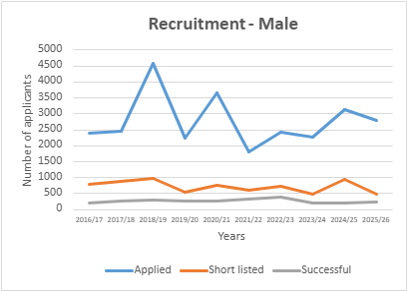
Chart 11 below illustrates the number of applicants who identified as women, were short-listed and were successful between 2016 and 2026.
Chart 11
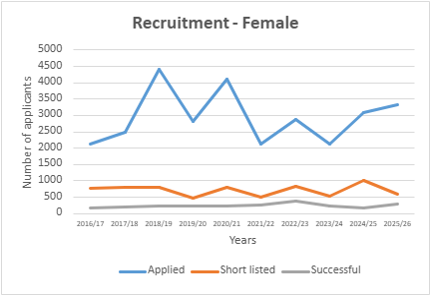
Of all applicants, 0.7% preferred not to disclose gender at recruitment stage (1.1% in 2024/25).
8. Starters and leavers
8.1 Age
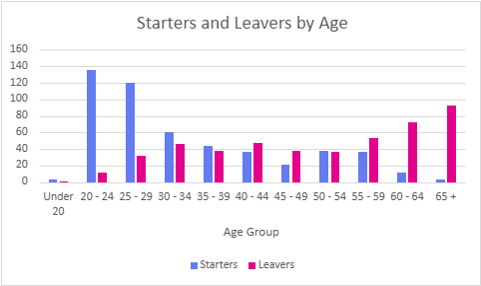
Chart 12 illustrates that while between the age group of 20 – 39, there are more starters than leavers, from age 40 onward there are more leavers than starters.
Chart 12
8.2 Disability
Of the staff joining the Service, 1.6% disclosed they had a disability (1.2% in 2024/25) and of those leaving, 0.9% disclosed a disability (1.2% in 2024/25).
8.3 Gender reassignment
Numbers are too low to report.
8.4 Ethnicity
11 members of staff joining SAS and 6 members of staff leaving disclosed they are from ethnic backgrounds.
8.5 Religion or belief
Chart 13 illustrates the number of starters and leavers by religion or belief.
Chart 13
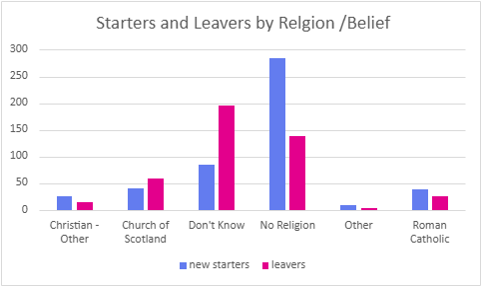
Of those staff joining the Service, 79.6% disclosed religion or belief with 51.9% of those leaving doing so. There are more staff leaving who hold Church of Scotland and Christian, or have no religious beliefs, as a stated religion, and more new starters who do not hold a religion. Of those joining SAS, 56.1% have disclosed that they do not have a religion with 29.5% of leavers doing so.
8.6 Sexual Orientation
Of those staff joining the Service 81.9% disclosed sexual orientation with 51.7% of those leaving doing so. Staff joining were more likely than leavers to disclose that they were lesbian, gay, bisexual or other. 11.2% of new starters disclosed that they were LGBTQ+ compared with 2.8% for leavers.
8.7 Sex
Chart 14 illustrates the number of starters and leavers by gender between 2016 and 2026. 60% of new starters were women (61.3% 2024/25). Women leaving SAS accounted for 47.4% of the total leavers compared with 44.6% in 2024/25. The number of female staff has steadily increased over the last years and now represents 49% of the total workforce.
Chart 14
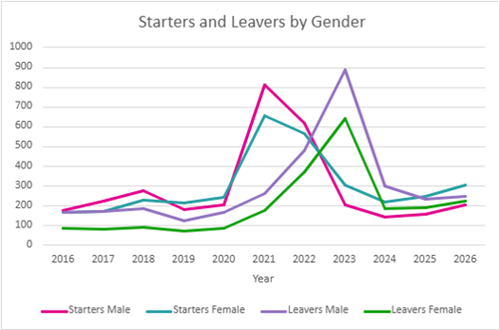
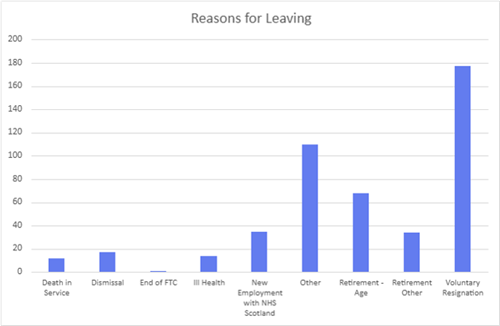
Chart 15 details the reasons given for employees leaving the organisation. 56.9% of those leaving the Service voluntarily resigned or retired, with 3% leaving due to ill health. 0.2% of employees left due to the end of their fixed term contract.
Chart 15
9. Training
The following breakdown covers training attended by staff across SAS on vocational qualification programmes delivered across regions (Ambulance Care Assistant and Trainee Ambulance Technician). These numbers are lower than we have seen historically due to the number of Newly Qualified Paramedics being recruited.
9.1 Age
Chart 16 illustrates the number of staff who undertook training by age group.
Chart 16
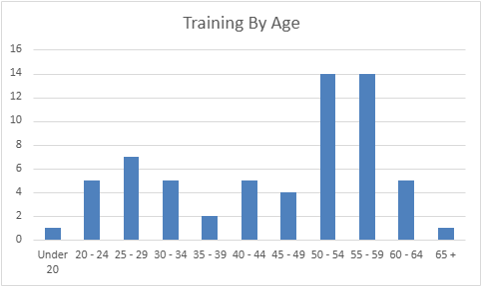
The age group with the highest number attending training is 50-54 and 55-59 years (14%).
From the data, age does not seem to have an influence on the incidence of training opportunities. For example, the vocational qualification programme (Ambulance Trainee Technician) attracted a broad range of students.
The vocational qualification courses attracted both internal and external applicants. SAS attracts a broader range of students than those reported by most undergraduate Paramedic programmes in the UK where students tend to be under the age of 25.
9.2 Disability
Numbers are too low to report
9.3 Gender reassignment
Number remains too low to report.
9.4 Ethnicity
The majority of staff completing training were white Scottish / white British / any other white background and accounted for 94.6% (73.2% in 2024/25).
9.5 Religion or Belief
Religion or belief was unknown for 7.9% of those staff who completed training. 17.5% of staff disclosed Church of Scotland, 9.5% Roman Catholic and 52.4% disclosed no religion or belief.
9.6 Sexual orientation
Sexual orientation was unknown for 17.5% of those staff who completed training. 7.9% disclosed a sexual orientation of lesbian, gay, bisexual or other.
9.7 Sex
Of those staff taking part in training 31.7% were women, compared with the overall workforce establishment of 49%.
10. Disciplinary & Grievance
10.1 Age
There were 28 disciplinary cases in 2025/26 compared with 56 cases in 2024/25.
Chart 17 shows the disciplinary cases by age. The age category 40 – 44 saw the highest number of cases, with the lowest numbers being in the 20 – 24 category.
Chart 17
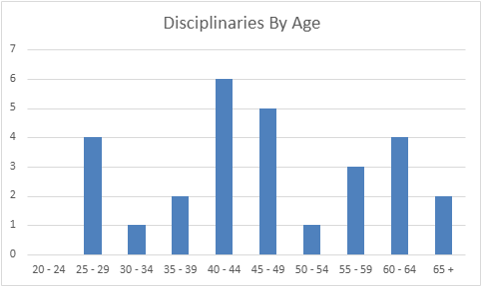
A total of 34 grievances were raised during 2025/26 compared to 43 in 2024/25. The category with the highest number of grievances was 55-59 years.
10.2 Disability
Numbers are too low to report.
10.3 Gender reassignment
None of the staff who went through a disciplinary or grievance procedure disclosed gender reassignment.
10.4 Ethnicity
Numbers are too low to report.
10.5 Religion or Belief
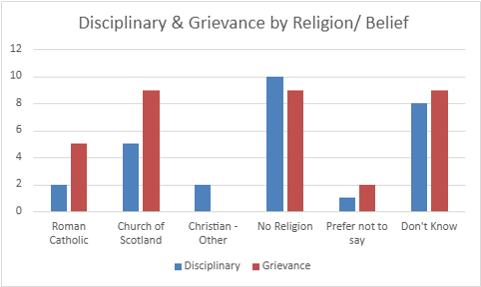
Chart 18 shows the religion / belief details of staff who went through a disciplinary or grievance. The majority of staff who went through a disciplinary or grievance procedure had not disclosed their religion or belief or had no religion.
Chart 18
10.6 Sexual Orientation
33 staff who went through a disciplinary or grievance procedure were heterosexual. The numbers are too low to report in the other categories.
10.7 Sex
Chart 19 illustrates the number of males and females who have gone through the disciplinary or grievance procedure for the years 2016 - 2026.
Chart 19
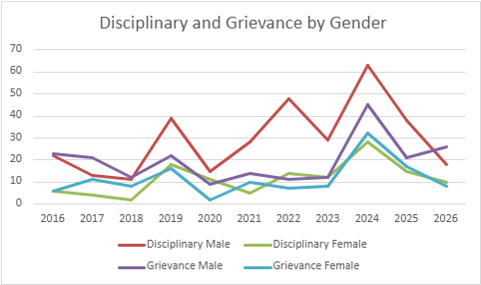
Of the instances of disciplinary and grievance during the period 2025/26, a higher proportion of men went through these processes than women. For disciplinary, 64.3% of activity involved men and for grievance 76.5% involved men, compared with the workforce establishment of 51% men
11. Appraisals
The system for recording development activity across NHS Scotland has moved from the electronic Knowledge and Skills Framework to the Turas platform.
11.1 Age
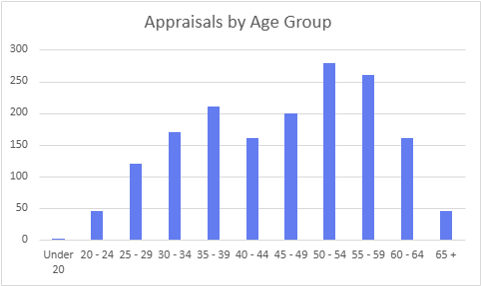
Chart 20 illustrates the number of staff completing appraisals by age group. This pattern is broadly reflective of the whole workforce profile.
Chart 20
11.2 Disability
Of those staff completing appraisals, 2.1% disclosed a disability.
11.3 Ethnicity
The majority of staff completing appraisals were from white Scottish/ white British backgrounds and these accounted for 79.5% with 0.9% from BAME backgrounds.
11.4 Sex
45.6% of those completing appraisals were women, slightly less than last year (45.9%). 54.4% were men
12. Redeployment
A total of 56 staff were included on the redeployment register during the period 2025/26.This reflects changes in the health of individuals, organisational changes and adherence to the policy of no compulsory redundancies. 58.9% of staff (33) were on the register because of capability and ill health, 21.4% (12) due to the end of a fixed term contract and 19.6% (11) for other reasons including organisational change / performance.
Table 11
| Number of employees | Redeployed | Awaiting redeployment | On trial redeployment | No longer requiring redeployment | |
|---|---|---|---|---|---|
| Total | 56 | 21 | 15 | 2 | 18 |
Table 11 illustrates the number of staff that have been redeployed during this period, those still awaiting redeployment as of 31st March 2026 and those who no longer require to be redeployed.
12.1 Age
Staff between the ages of 50 - 59 accounted for the largest proportion of those on the redeployment register representing 33.9%.
12.2 Disability
Less than five staff members on the redeployment register have disclosed a disability. For 23.2% of staff this was not disclosed / unknown.
12.3 Gender reassignment
Numbers are too low to report on.
12.4 Ethnicity
Most staff on the register disclosed that they were from white Scottish / white British backgrounds (71.4%). This is in keeping with the workforce where the majority of staff self-disclosed as white Scottish / white British. For 23.2% of staff this was not disclosed / unknown.
12.5 Religion or belief
Of those staff on the register, 33.9% had disclosed religion or belief. 33.9% disclosed no religion.
12.6 Sexual orientation
Of those staff on the register 53.6% had disclosed sexual orientation, 1.8% of which were from the LGBTQ+ community.
12.7 Sex
48.2% of those staff on the register were female compared with the 49% of females within the total workforce.
13. Promotions
13.1 Age
During 2025/26, 273 staff were promoted. The chart below illustrates the number of promotions against age groups.
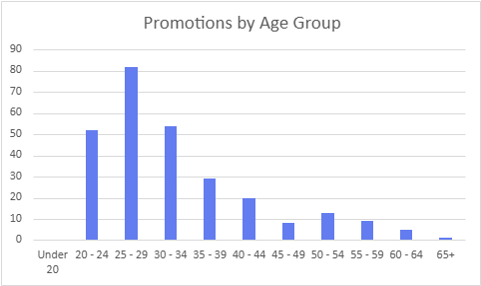
Chart 21 illustrates the spread of promotions across the age groups, with the most promotions being earned by 25–29-year-olds (32%).
13.2 Disability
Of those staff promoted 1.5% disclosed they had a disability.
13.3 Gender reassignment
Numbers are too low to report on
13.4 Ethnicity
The majority of staff promoted were white Scottish / white British (80.2%). 85% of staff promoted had disclosed their ethnicity.
13.5 Religion or belief
Of those staff promoted 79.1% had disclosed religion or belief. 13.6% disclosed Church of Scotland, 7.2% Roman Catholic and 53.1% had no religion / belief.
13.6 Sexual orientation
Of those staff promoted 79.8% had disclosed sexual orientation. 67% identified as heterosexual and 11% identified as gay, lesbian, bisexual or other.
13.7 Sex
Of those staff promoted 61.2% were female.
Chart 21 illustrates the spread of promotions across the age groups, with the most promotions being earned by 25–29-year-olds (32%).
14. Actions taken and new steps
We said in our 2023/24 workforce equality monitoring report that we would take a number of steps. This is what we did, the results and what we plan to do next. Actions in this area are linked to Equality Outcomes 5 and 6 (Mainstreaming Report 2025-29).
14.1 In order to improve equality disclosure rates a plan is in place to increase awareness of this and the importance of collecting the data
| Actions | Results | Next Steps |
|---|---|---|
| As detailed in 5.2 | As in 5.2 | As in 5.2 |
14.2 We will investigate why those in 16 - 25 age group applying for posts are least successful at interview stage
| Actions | Results | Next Steps |
|---|---|---|
|
Much of this remains dependent on cost and available resources. Our Community Engagement Manager and Communications team are working with local management teams on how we can better support school career and education events. The data is limited in terms of lack of success of under 20 age group. The aim is therefore to encourage and support a career with SAS. Further investigation will be undertaken to establish with recruiting managers to understand why younger applicants are not being successful at interview stage |
School and career events continue to be attended on an ad hoc basis. Applications from young people between the ages of 15 - 24 represented 13.1% of all applications (12.7% in 2024/25). 20.9% of all applicants in this group were successful. (8.4% in 2024/25) |
We will aim to attend more events and others which are for young people. Much of this will be dependent on cost. Local management teams are often requested to attend school events and we will look at how we can support them across SAS. We will continue to explore more opportunities for training and development for young people |
|
All networks will be expected to produce annual workplans on a regular basis and report these to our Equalities Steering Group.. The Mainstreaming and Equality Outcomes for 2025-29 will take into account workplans and developments across all of our Equality networks. Our EDI Communications plan will be updated regularly and will be linked with our strategics aims of our 2030 strategy. |
We have regular input with Ambulance Services networks and through guidance produced and discussion we share practice and learning. We have promoted via Staff Engagement sessions, development of @SAS of our own Ethnic Minority Forum, Proud@SAS, our LGBT Network, Disability, Gender Equality and Veterans Network to help to promote inclusion and provide support for people joining SAS. All SAS networks produce regular updates for the Equality, Diversity and Inclusion Steering Group |
We will continue to link with other Ambulance Services through the BME Forum, LGBT Network, Disability Network and Diversity & Inclusion Forum in order to share learning. We will increase the cover at these meetings across the Service to encourage shared ownership of the work that needs to be done in these areas. Our new Equality and Diversity Project Officer will work to streamline our governance processes, systems and coordination of our networks and EDI activity. Our Communications lead will help support our overall aims in our Mainstreaming and Equality Outcomes strategy through our communications plan. |
14.3 Applicants wishing to join SAS will be encouraged to provide equality monitoring information
| Actions | Results | Next Steps |
|---|---|---|
|
We will review the information which goes out with our application packs and look at how we can promote the completion of equality monitoring information, to ensure the best candidate experience. Digital forms have been developed and will be rolled out in 2024/25 for any new training courses. We will look at how this could be included within the recruitment process for all new applicants and candidates for interview. |
The proportion of applicants who have chosen not to disclose their age has decreased to 0.3% in 2025/26, from 1.2% in 2024/25. Disclosure of other equality details improved with fewer applicants completing the “preferring not to answer” questions. |
We will investigate if the format of the equality monitoring section on Job Train is different to that on the Talent Link system previously and identify if changes could be made to encourage disclosure of age details. |
14.4 We have identified that there has been an increase in the number of applicants from minority ethnic, disabled groups and applicants disclosing gender reassignment
| Actions | Results | Next Steps |
|---|---|---|
|
We will continue to monitor success rates of applicants from BAME backgrounds and from those who have a disability. We will investigate success rates of BAME applicants from different groups to establish if there are actions that can be taken in order to make improvements. |
0.3% of all BAME applicants were offered posts.(0.3% in 2024/25) 15% of applicants from disabled backgrounds were successful (15.3% previously) In comparison the success rate for all applicants applying for posts during 2025/26 was 8.8% (6.2% previously) |
We will continue to monitor success rates of applicants from BAME backgrounds, those who are disabled and those who have disclosed gender reassignment. |
15. Conclusion
We recognise that equality monitoring is a means and not an end in itself. The purpose is to have information to inform us about how well we reflect the communities we serve in relation to diversity and protected characteristics. Work over several years indicates improvement in some areas; however, we are still striving to gather robust equality data for our workforce, and to increase self-disclosure response rates. We are making progress, and our plans are set out in this report about areas where we would like to improve, and priorities to focus on.
In order to provide a more comprehensive overview of our progress in equality monitoring, future equality monitoring reports will also look at intersectionality and where we can make improvements in areas where protected characteristics are linked. Whilst there remains more work to do, the evidence within this report suggests that the Service is becoming a more equitable organisation. Improvements in workforce representation, recruitment outcomes, progression opportunities and employee engagement demonstrate positive movement towards ensuring that staff from all backgrounds have fair access to opportunities and support across SAS.
Appendix 1
Highlights of other Equalities Work from September 2024 to September 2025
Since the publication of our Mainstreaming Equality and Diversity in the Scottish Ambulance Service 2025-29 report, we would like to highlight a few areas of work which outline the ongoing commitment to support the strategic aims outlined in that report.
- Our overall Equality, Diversity and Inclusion Steering Group is now well established and is led by the Deputy Chief Executive/Chief Operating Officer and Equalities lead for the Service. The group continues to provide strategic leadership on equality, diversity, inclusion (EDI) and human rights across the Scottish Ambulance Service (SAS) and to support the Service to deliver on this critical agenda. The focus of EDISG is to assist our service to ensure that our workforce reflects the local communities served and delivers improved health outcomes for patients across diverse populations. The aim is to listen, learn, and spread the scale of best practice. Our Annual workplan for EDI is based on our overall aims contained within our Mainstreaming, Equality Outcomes, Equality Monitoring action plans.. Partnership are fully involved in all aspects of EDI work.
- We have a clear communications plan which includes improved website (@SAS), newsletters, Teams channels, development of SAS cultural calendars and updates. Through the Communications lead for Equalities, we will continually update and develop this plan.
- CPD sessions have been developed by our OD team, for all staff and will be regularly reviewed to include any policy, or legislative changes.
- EDI objectives, in particular for Race Equality are now fully incorporated into annual objectives and our Anti-Racism plan is due to be published shortly.
- We are key partners across AACE, NHSS and other emergency services driving forward the Reducing Misogyny Improving Sexual Safety work
- We provide benchmarking opportunities across AACE and wider NHSS
- We have engaged in pieces of work across wider NHS and Ambulance services e.g. updating JRCALC guidelines, from an EDI perspective. We are now engaged with the Public sector Equality Improvement group, led by Scottish Government.
- Map priorities within NHS 24 and SAS EDI Action Plans and agree areas for joint work.
- Establish a joint oversight group and agree shared objectives, success measures, and workforce-aligned benefits.
- Review progress annually, seeking to expand shared objectives of joint oversight group and mainstream approach. Our staff networks are all now well established across SAS. These are the Unity in Diversity (previously named, Ethnic Minority Forum) Forum, the Proud@SAS Network for Lesbian, Gay, Bisexual & Transgender + (LGBT+) staff, Enable Disability Network, Gender Equality Network and Armed Forces Network. The networks are for staff from all the communities, across SAS, who share protected characteristics, their allies and those that can influence change and support developments across the Service.
- Staff side colleagues are also represented on all of our networks.
- We have completed the annual report on actions coming from the Second Edition of our Gaelic Language Plan was approved by Bòrd na Gàidhlig for the second edition of the Scottish Ambulance Service Gaelic language plan.
- Work across all of our Mainstreaming and Equality Outcome objectives is ongoing. The Equality Outcome objectives for 2025-2029 have now been published.
- NHS24 Collaboration work - As part of the overall NHS24 Collaboration work we are progressing a number of initiatives at pace. We are aiming to build a shared equality and inclusion learning programme across both Boards. We will work collectively to align our equality, diversity, and inclusion approaches, as detailed below:
- Map priorities within NHS 24 and SAS EDI Action Plans and agree areas for joint work.
- Establish a joint oversight group and agree shared objectives, success measures, and workforce-aligned benefits.
- Review progress annually, seeking to expand shared objectives of joint oversight group and mainstream approach.
- Deliver joint activity/awareness sessions related to anti-racism.