Feedback, Comments, Concerns and Complaints Annual report 2024 - 25
Contents
Encouraging and Gathering Feedback
Encouraging and Handling Complaints
Learning from Feedback: Involving People
Next Steps/ Areas for Improvement
1. Introduction
Statement from our Chief Executive, Michael Dickson OBE
A Year of Achievements and Innovation
This year brought its share of challenges, yet it also provided many opportunities for growth and transformation. Although we have experienced significant pressures, such as hospital turnaround times, we have continued our ongoing efforts with health board colleagues to support improvement. What has stood out is the remarkable dedication of every team member at the Scottish Ambulance Service - from the frontline to our steadfast support staff. We celebrated numerous achievements and innovative successes at SAS, and we are proud of the outstanding work taking place across our entire organisation.
Every year, about 1.1 million people reach out to the Scottish Ambulance Service—roughly 3,000 calls each day—with an additional 410,000 calls handled by our Patient Transport Service. This is an insight into the breadth of service we offer and reinforces our commitment to those we care for. We are constantly evolving and seeking to excel in the quality of care we deliver.
Our specialist teams have played a vital role in our response to the people of Scotland this year. The Special Operations Team (SORT) responded to 5,081 incidents, demonstrating exceptional skill in high-risk environments, while our base at Newbridge—opened in 2023—continues to offer dynamic training that elevates our service standards. Likewise, our ScotSTAR teams have successfully retrieved patients needing specialist care, including trauma patients and premature babies, ensuring they receive critical treatment sooner.
In Scotland’s most remote areas, our Air Ambulance crews have provided a lifeline. Their swift, skilled responses continue to connect patients in distant regions with lifesaving care every day. We also applaud our partners at Scotland’s Charity Air Ambulance (SCAA) and celebrate the award of the Air Ambulance Service contract to GAMA Aviation after an extensive Re-Procurement Project - a significant milestone that demonstrates our commitment to the future of our air service.
We also want to give a huge shout-out to the over 1,000 volunteers including our Community First Responders and Community Cardiac Responders. Their selfless work ensures immediate assistance in emergencies, directly empowering our ambulance response. We remain deeply grateful to all our volunteers and are continuously exploring new ways to support this indispensable group.
A key focus this year has been optimising our service efficiency, initiatives like our evolving Pathway Hub and Integrated Clinical Hub (ICH), we managed an impressive 156,144 calls and avoided 60,429 unnecessary ambulance journeys since April 2024. Adding senior managers on-site at hospital locations allowed us to directly channel valuable feedback and continuously enhance our operations.
Innovation has been at the heart of our progress. Our Enhanced Video Triage (EVT) Feasibility Study, for instance, has redefined how we assess suspected stroke patients via live video streaming—delivering faster, more accurate care long before our ambulances arrive. This breakthrough highlights our commitment to exploring new frontiers in pre-hospital stroke treatment.
Project CAELUS has kept its momentum by pushing the boundaries of medical logistics with drone technology. As a key partner in developing the UK’s first drone-enabled medical logistics network, SAS conducted a simulation study examining the feasibility of delivering an automated external defibrillator (AED) via drone, this is an exciting glimpse into the future of emergency care.
Our commitment to community wellbeing also shone through with the expanded TRUST initiative; Take it Seriously, Ring 999, Use first aid skills, Stay with them, Tell us what they’ve taken. Following a successful pilot, this program encourages young people to act decisively in drug-related emergencies. By breaking down fears and ensuring immediate support, TRUST is making a positive impact on community safety.
We extend our heartfelt thanks to everyone involved in the End-of-Life Care Project. Concluding after a transformative three-year partnership with Macmillan Cancer Support, this initiative enhanced palliative care across Scotland. By engaging with hospices and optimising care in patients’ preferred settings, we successfully reduced hospital conveyances and elevated the quality of end-of-life care.
Our efforts in remote healthcare also progressed this year, as advanced paramedics continue to pioneer innovative roles between SAS and NHS Western Isles (NHSWI). This flexible approach treating patients in homes, care settings, and even on GP home visits ensures that even Scotland’s most remote communities receive outstanding medical care.
Recognising the importance of holistic care, we have bolstered our commitment to mental health support. Through an enhanced partnership with NHS 24 and Police Scotland, our Mental Health Pathway now delivers immediate, appropriate support to those in urgent need ensuring that mental well-being is treated with the same unwavering dedication as physical health.
In conclusion, I want to express my deepest gratitude to all our staff and volunteers for their passion, perseverance, and commitment during this dynamic year. Their unwavering dedication is the true heartbeat of the Scottish Ambulance Service, and together, we continue to make a lasting difference.
2. Encouraging and Gathering Feedback
We actively promote a range of methods by which members of the public can feedback their experiences of the Scottish Ambulance Service. Email and telephone continue to be the primary methods of contacting us, but the public continue to use online channels such as Facebook, Twitter, the Scottish Ambulance Service website and Care Opinion. We also encourage feedback through the Citizens Advice Scotland ‘Patient Advice and Support Service’.
The vast majority of our feedback is positive and any comments from patients, their families, carers or members of the public are fed back directly to the staff involved and their manager.
Where negative feedback is involved, a thorough investigation is undertaken where we will talk to people who made complaints to explain what happened, outline where any lessons have been learned and where improvements may have been made. In certain cases, formal face-to-face meetings are offered and, where appropriate, a sincere apology offered.
We continue to promote Care Opinion as a valuable channel for feedback from patients, families and carers who would rather express their views anonymously or indirectly to the Service. The website allows their voice to be heard on a national forum and gives us a great opportunity to engage with them about the care they received or assist them with any ongoing issues.
About Care Opinion
Care Opinion is a place where you can share your experience of health or care services, and help make them better for everyone.
At Care Opinion we make it safe and simple to share your story online and see other people's stories too. You can see how stories are leading to change.
We think that by sharing honest experiences of care, we learn to see the world differently. Working together, we can all help make care better.
The Service is dedicated to reviewing and responding to every post to support patients and their families and this year we responded to 99% of stories within 3 days. The Service is also keen to identify learning from the feedback we receive.
Between 1 April 2024 and 31 March 2025, 348 stories were posted on Care Opinion relating to the Service. This is a 10% increase from the volume posted the year before. On 30 July 2025 these have been viewed 83,126 times.
Of the 348 posts, 72% were uncritical in tone. It should be noted that whilst the remaining 26% will have some form of criticality, this is not necessarily directed towards the Service, with the feedback often involving multiple NHS boards.
Compliments
Compliments received from sources other than social media are logged and actioned on our feedback system InPhase. Between 1 April 2024 and 31 March 2025, a total of 1040 compliments have been received which is similar to the previous year. Public support for the remarkable work of our staff continues to be strong.
Social Media Management
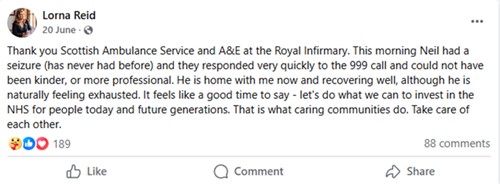
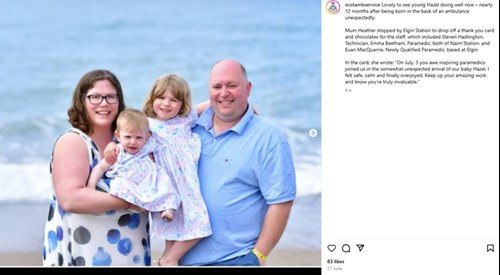
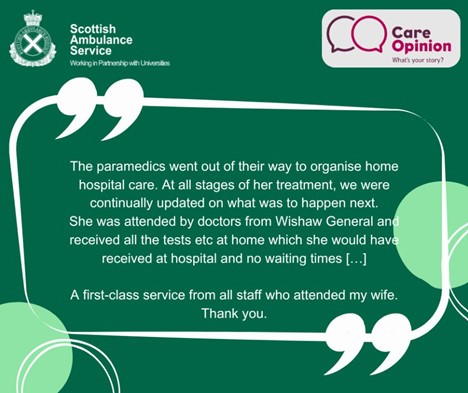
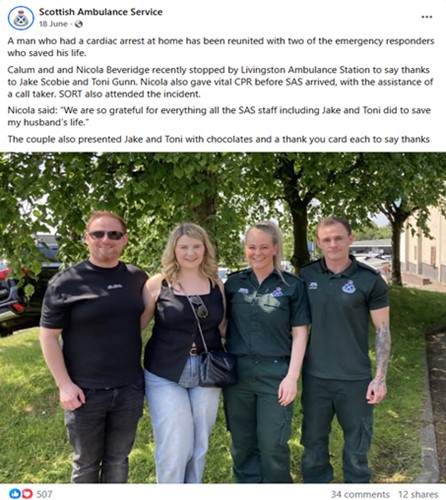
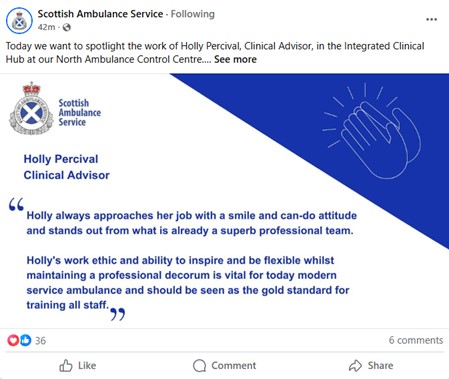
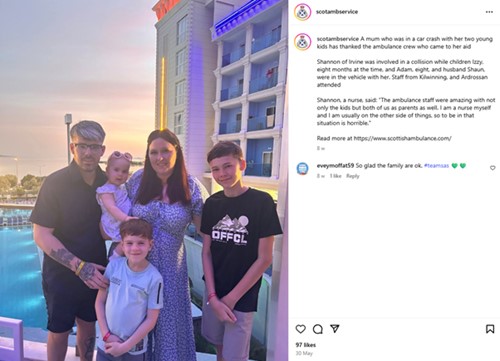
Many of our compliments are received via digital media channels such as Facebook, Twitter, Instagram and our website and this positive feedback continues to grow. Over the year, we have received a huge number of compliments through our social media channels, too many to count. In addition, engagement on social media continues to grow. In 2024, we hit a new milestone of more than 100,000 followers on our social media accounts combined, a 5% increase on 2023. Our social media posts were also viewed more than 10 million times. However, there appears to be a downward trend for users and engagement on X with Facebook and Instagram having a lot more users and engagement. Below is a small snapshot of the compliments that we received in 2024/25, each one praising our fantastic staff:
3. Encouraging and Handling Complaints
On the 1 April 2017, NHS Scotland implemented a new NHS Complaints Handling Procedure (CHP). This was put in place to improve and standardise how all NHS Boards handle complaints. There is now a two-stage process in place. If at the end of this process, the complainant is not satisfied with the outcome, they are sign posted to the Scottish Public Services Ombudsman (SPSO).
Stage 1 - Early Resolution
Make your complaint directly to the NHS board. The Service will try to resolve your complaint within 5 working days if they can. They may respond to you by phone or in person to try and resolve things. If you are unhappy with the response, you can ask the Service to consider your complaint at Stage 2.
Stage 2 - Investigation
If your complaint is complex or needs a more detailed investigation, the organisation may look at your complaint immediately at this stage without going through stage 1. At stage 2 you should receive an acknowledgment of your complaint within three working days. You will be given a decision as soon as possible. This should be after no more than 20 days working days unless there is clearly good reason for needing more time.
The Scottish Public Services Ombudsman (SPSO)
If, after receiving the final decision on your complaint, you are still unhappy you can ask the SPSO to consider it. The SPSO is an independent and free service. The Service will tell you about the SPSO when they send you their final decision.
During 2024/25, 1,128 complaints were received. This is a slight increase of 15.34% on the previous year. Of these complaints, 619 were ‘Stage 1’ complaints and 509 were ‘Stage 2’ complaints. To provide some context, the number of complaints received by the Scottish Ambulance Service in 2024/25 represents only 0.1% of all the 999 calls (926,894) we received asking for our assistance.
While complaints handling is co-ordinated and quality assured by the Patient Experience Team, complaints are investigated in each region by local staff who will contact the complainant and any staff members involved to look into the issues raised and resolve the situation.
Early conversations with the complainant help to put in place a proportionate review or investigation into the circumstances that led to the complaint. Local managers have access to report functions in order to understand what is working well and to identify areas for improvement. The Patient Experience Team reviews feedback data at a national level to identify any emerging trends that might relate to systemic issues.
There are a number of assurance groups within the Service to ensure that we take the learning from all complaints and use this valuable feedback to improve our services further. We also work closely with other health boards and ambulance services across the UK.
4. Accountability and Governance
We ensure patients and carers continue to have access to a range of feedback options for providing feedback to the Service.
Complaints handling is co-ordinated by the Patient Experience Team, with each complaint looked into at a local level to drive improvement, while identifying any issues that require national consideration.
Complaints trends and themes are shared in a patient experience paper that is a standing item at our Clinical Governance Committee meetings and our Public Board meetings. This helps our Clinical Governance Committee and Board track feedback and complaints, making sure the right staff take action to improve and share good practice.
Complaints Compliance
Guidance states that all NHS Boards in Scotland should aim to respond to 70% of ‘stage 1’ complaints within five working days and 70% of ‘stage 2’ complaints within 20 working days.
The Scottish Ambulance Service again finished the year well over the Government Target for both Stage 1 and Stage 2 complaints. There is no doubt that this strong performance is down to the hard work, dedication and professionalism shown by the staff who are all involved in the Service’s complaints handling.
Although there has been a slight dip in compliance - Stage 1 at 95.8% (down from 97.4%) and Stage 2 at 91.6% (down from 94.6%), these remain excellent results, particularly in light of recent staffing capacity challenges within the Patient Experience Team.
Scottish Public Services Ombudsman (SPSO)
The Scottish Ambulance Service continues to have a positive and co-operative relationship with the Scottish Public Services Ombudsman.
In 2024/25 there were 5 SPSO cases fully investigated, this is one less than the previous financial year. Of these 5 cases, one is still being reviewed, two complaints have been upheld and two have not been upheld. When a complaint is upheld or partially upheld, the Scottish Ambulance Service often begins making improvements before the SPSO’s findings are formally issued. If further action is needed, a plan is put in place to complete the recommendations.
5. Learning from Feedback- Involving People
Feedback, whether positive, negative or constructive is something we value deeply within the Scottish Ambulance Service as it is a great opportunity for us to learn, improve and shape our Services. In addition to traditional feedback processes such as compliments and complaints, we actively work in partnership with patients, their families, the public and Third Sector organisations across the country to co-design and improve the services we provide to communities. We have a wide-ranging ‘Involving People’ network that works in partnership with our staff throughout the year. This year, we’ve continued to strengthen how we support and involve volunteers, young people, and communities across Scotland.
Supporting Our Volunteers
We’ve been working to improve how we support our Public Focused Public Involvement (PFPI) volunteers. Based on feedback from volunteers, NHS partners, and other ambulance services across the UK, we’ve launched a new volunteer portal on our website. This provides clear, helpful information about the PFPI role, how the Scottish Ambulance Service (SAS) works, and how volunteers can make a real difference. The feedback so far has been very positive.
We’re also improving how we recruit PFPI volunteers by using best practice from Healthcare Improvement Scotland and the London Ambulance Service. This helps us reach more people and make the process more inclusive.
In line with our Equality Outcomes and NHS Scotland’s Participation Standard, we’re continuing to recruit patient representatives to join key committees and governance groups.
Celebrating Community Engagement
We’re encouraging staff to share and celebrate the work they do in communities, such as school visits and public events. Regional directors are now writing to staff to thank them and encourage more of this work, making sure it’s well-coordinated and follows the latest guidance. This helps us recognise great work, raise awareness of local engagement, and stay accountable to the communities we serve.
We’re also working with other public sector organisations to share community engagement resources, including equipment. This supports our goals in The Anchor Plan and the wider aims of the Community Empowerment (Scotland) Act 2015.
Engaging Young People
We’re continuing to involve young people in meaningful ways. One exciting project involves working with our Ambulance Control Centre teams to create a dramatised version of a real emergency call, where a call handler helped someone deliver a baby at home. This will give students a realistic insight into the skills and challenges of emergency call handling.
This case study will be part of a new programme we’re co-designing with students from Queen Margaret University’s Paramedic Science course. The aim
is to inspire young people to consider careers in healthcare and to link our work with what’s being taught in schools and universities.
Mental Health and Peer Support
We’re continuing to develop our mental health training for Scheduled Care staff, in partnership with the Scottish Recovery Network. This training is based on the principles of Realistic Medicine and aims to help staff manage their own mental health and support each other.
Workshops and co-design sessions have taken place across our ambulance control centres, and peer support networks are now starting to form. This work supports NHS Scotland’s Workforce Strategy 2031 and our wider focus on staff wellbeing.
Youth and Community Partnerships
Together with NHS 24 and NHS Lothian, we’re developing new work experience opportunities that give students a full view of emergency care from the 999 call to hospital discharge. We’re also creating a mentorship scheme to help young people build leadership and communication skills, supported by SAS staff.
The Scottish Ambulance Service remains dedicated to continuous improvement and ensuring that every department remains patient focused. Through these ongoing efforts, we strive to provide the highest quality care and support to all our patients.
6. Next Steps / Areas for Improvement
While the report highlights strong progress in many areas, there are opportunities to build on this work further. The following suggestions are offered for consideration and future development:
- Proactive Engagement: There is already good work underway to engage the public, but more targeted outreach to underrepresented and equalities groups could be beneficial. One idea is to develop a feedback engagement plan specifically aimed at reaching these communities.
- Learning from feedback; to improve transparency and demonstrate how feedback leads to change, the Service could explore creating a public-facing “Feedback in Action” dashboard on the SAS website. This might include clearer links between feedback and outcomes, such as a “You Said, We Did” feature.
These suggestions are intended to support ongoing improvement and help strengthen the connection between public feedback and service development.
7. Conclusion
We are proud to see continued high levels of positive feedback across all our channels, reflecting the dedication and professionalism of our staff and volunteers. We are especially grateful to everyone who has taken the time to share their experiences, your feedback is vital in helping us shape and improve our services for communities across Scotland.
We also extend our sincere thanks to the many individuals, families, volunteers, and third sector partners who have worked alongside us to co-design and enhance our services. Their contributions have been instrumental in driving innovation and ensuring our care remains person-centred and inclusive.
Despite some challenges, including staffing pressures, our teams have continued to deliver excellent service and embrace new ways of working, from digital innovation to community engagement and mental health support.
We hope this report demonstrates how your feedback is being used to make meaningful improvements, and we remain committed to listening, learning, and evolving to meet the needs of those we serve.